Reflection on the Wedding at Cana
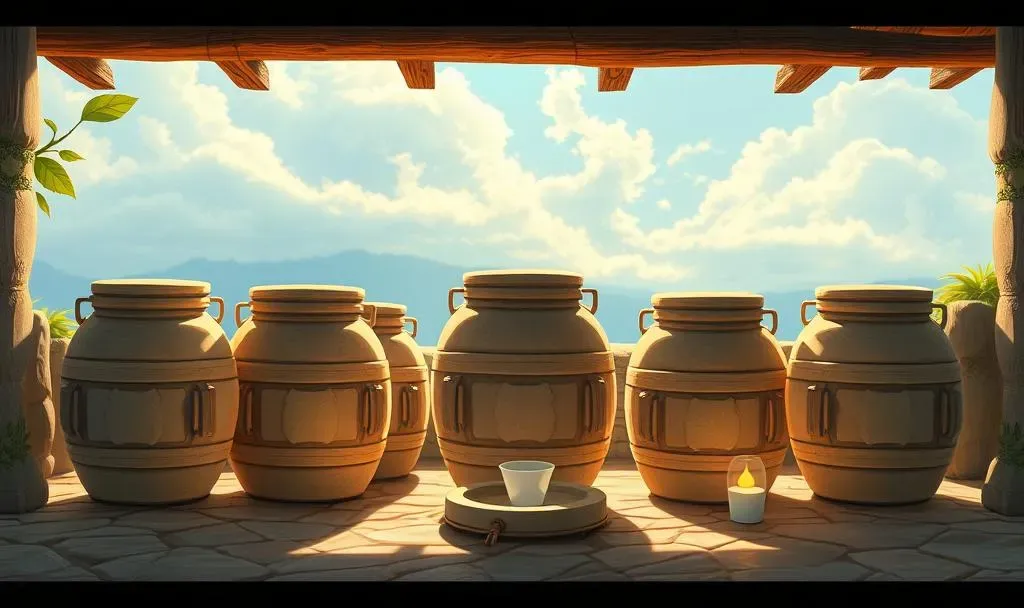
Jesus takes water in jars of stone and gives it new meaning with a miracle at a wedding.
I wanted to share a short reflection on John 2:6-11, which is a story about Jesus’ first miracle, where he takes water and turns it into wine. To read the entire context I recommend also reading verses 1-5, but for brevity I’ll only quote verses 6-11.
Below is from The Holy Bible: English Standard Version (Wheaton, IL: Crossway Bibles, 2016), John 2:7–11.
6 Now there were six stone water jars there for the Jewish rites of purification, each holding twenty or thirty gallons.
7 Jesus said to the servants, “Fill the jars with water.” And they filled them up to the brim.
8 And he said to them, “Now draw some out and take it to the master of the feast.” So they took it.
9 When the master of the feast tasted the water now become wine, and did not know where it came from (though the servants who had drawn the water knew), the master of the feast called the bridegroom
10 and said to him, “Everyone serves the good wine first, and when people have drunk freely, then the poor wine. But you have kept the good wine until now.”
11 This, the first of his signs, Jesus did at Cana in Galilee, and manifested his glory. And his disciples believed in him.
The first thing I notice is the vessel Jesus uses for the miracle. Verse 6 points out “six stone water jars,” which were used for Jewish ritual purification. Whether it was to clean oneself before eating¹, God gave the Jews plenty of rules on how to stay clean. There were many guidelines from the Old Testament² on how to deal with a diseased/moldy home, diseases on the skin, etc. Such situations were thought to have come from being in a state of sin and requiring atonement, so the Old Testament would have priests come into homes to inspect and perform rituals to make homes and people clean. The former requiring the use of bird blood, even.
In using these jars, Jesus gave new meaning to what it meant to be clean. What was important was not physical hygiene or appearing healthy when worshipping, but what our inner spiritual purity. We couldn’t achieve true purity through taking this water and doing the work ourselves to clean our bodies, but by Jesus taking all of the water and us drinking from His cup of wine - from the work that He did for us.
When the Jews were wandering after having escaped Egypt, Paul tells us that Christ was the spiritual rock and source of the living water that kept them alive³. In this passage, the life-giving water which sustained the Israelites’ physically is converted by Jesus into a drink of celebration and jubilee, for a wedding.
Jesus transforms what we desire when we work hard, into something that we enjoy when we at rest. The water into wine stands in stark contrast to transmutations of water into blood in the Bible. In Exodus 7, Moses turns the water of the Nile into blood, signifying judgment, sacrifice and death. I find it interesting that the wine in the cup of the New Covenant has a connection to this blood; something we can explore in a future post.
I can’t help but wonder what it would have been like to have been a disciple at that time, witnessing the wedding and the water being turned into wine. Would I have remained skeptical even after seeing the miracle? Or would I have been so blown away by what I saw that I immediately followed Jesus? In verse 11, John writes that the disciples believed in him after this miracle. The right people were there.
1 Mark 7:3-4
2 Leviticus 13, 14
3 1 Corinthians 10:4